Challenge Problems
Capstone Challenge Problems with Full Solutions

All of calculus is based on a single idea—the limit. In this chapter we discover how to communicate a function's behavior using limits, as well as their properties and how to compute limits analytically. In Section 1.4 we will use these ideas to define continuity, a vital topic on which further topics in calculus are based.
1.1 Defining a Limit
Informal definition of a limit. Estimation of limits from tables, graphs, and numerical approximations. Discussion of limits with infinity: limits at infinity and infinite limits. Defining vertical asymptotes.1.2 Evaluating Limits Analytically
Properties of limits. Limits of sums, differences, products, quotients, and compositions of limits. Calculating limits of indeterminate form \(\indZero\) by algebraic manipulation with factoring and rationalization.1.3 Squeeze Theorem and Trigonometric Limits
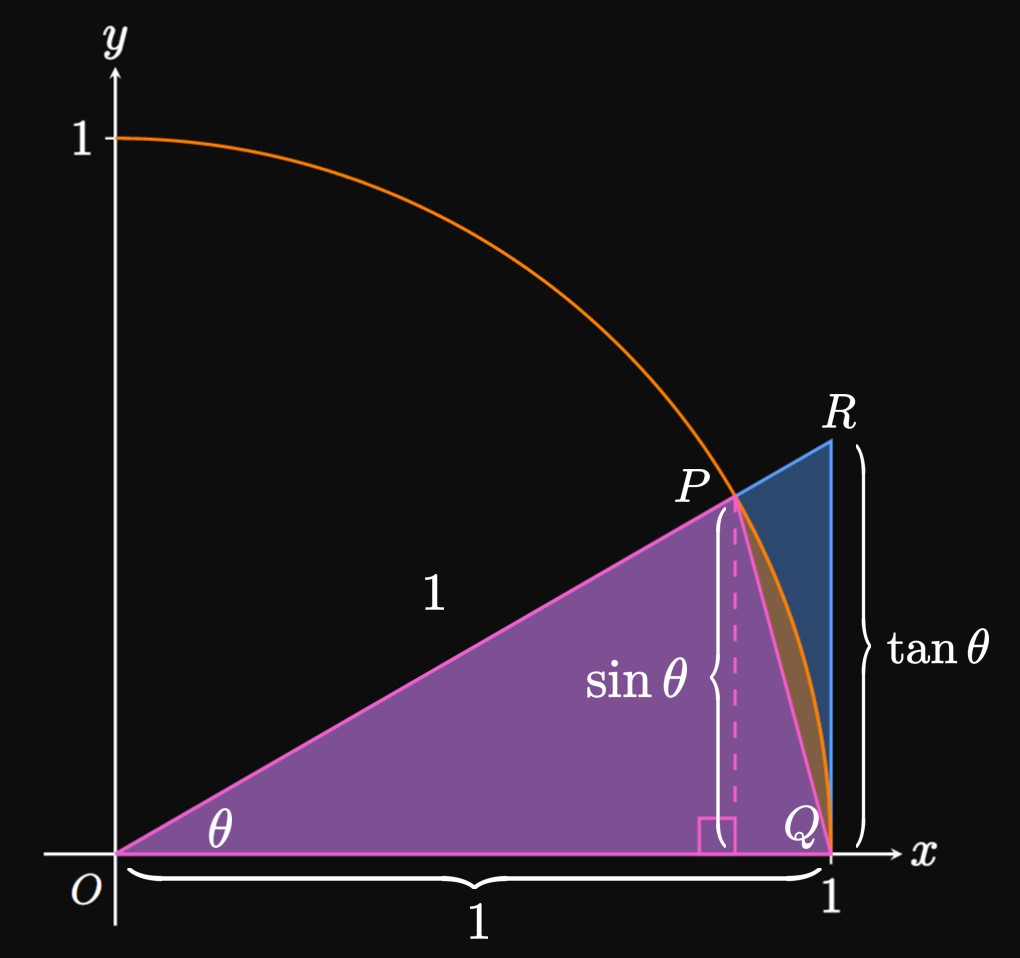
Introduction and proof of Squeeze Theorem. Derivation of the fundamental limits \(\sinLim{x} = 1\) and \(\cosLim{x} = 0.\) Evaluating limits analytically with trigonometric functions. Finding limits of composite functions by change of variable.1.4 Continuity
Formal definition of continuity. Finding intervals on which a sum, difference, product, quotient, or composition of functions is continuous, using limit properties.1.5 Formal Definition of a Limit
Use of error analysis, the Epsilon-Delta definition, to formally define a limit. Inclusion of geometric intuition and algebraic problem-solving.