Challenge Problems
Capstone Challenge Problems with Full Solutions

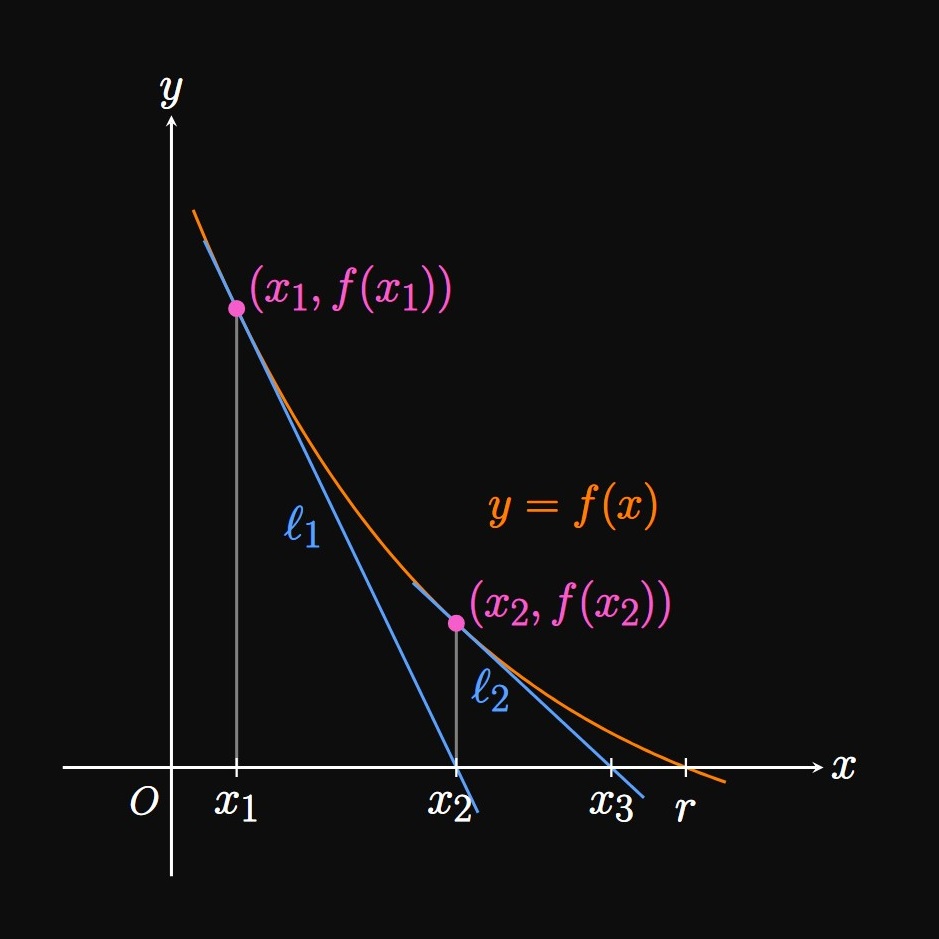
In Chapter 2 we trained ourselves in differentiating various combinations of functions. We applied derivatives to calculating slopes of tangents and relating position, velocity, and acceleration. Yet there are countless more applications of differentiation, all under the same universal idea—rates of change. In this chapter we use derivatives to find a graph's peaks and troughs (3.1); prove the existence of a particular rate (3.2); describe a graph's shape (3.3); further investigate particle motion (3.4); evaluate limits in indeterminate forms (3.5); optimize real-world quantities (3.6); analyze a firm's revenue, costs, and profits (3.7); and approximate the zeros of functions (3.8).
3.1 Minimum and Maximum Values
Defining absolute extrema and relative extrema. Introducing the Extreme Value Theorem and Fermat's Theorem. Determining critical numbers. Finding a continuous function's absolute maximum and absolute minimum over a closed interval using the Closed Interval Method.3.2 Mean Value Theorem and Rolle's Theorem
Overview and proof of Mean Value Theorem and Rolle's Theorem. Using Rolle's Theorem to prove the existence of zeros on an interval.3.3 Using the First and Second Derivatives
Discussion of first and second derivatives of a function and their effects on a graph. Intervals of increase and decrease. First-Derivative Test and Second-Derivative Test. Concavity and inflection points.3.4 Particle Motion
Detailed analysis of motion (position, velocity, and acceleration) along a straight line. Distance traveled and speed. Turning points. Conditions for speeding up and slowing down.3.5 Indeterminate Forms and L'Hopital's Rule
Evaluating limits of indeterminate forms: \(\indZero,\) \(\indInfty,\) \(0 \times \infty,\) \(\infty - \infty,\) \(0^0,\) \(1^\infty,\) and \(\infty^0.\) Relative growth and decay.3.6 Optimization
Minimizing or maximizing a given quantity using a systematic method. Inclusion of geometric, physical, numeric, and map problems.3.7 Applications of Differentiation in Economics
Law of Demand and demand functions. Introduction to revenue and cost functions, profit function, marginal cost functions, marginal revenue functions, and average cost functions. Maximizing revenue and profit.3.8 Newton's Method
Newton's Method to approximate zeros of functions and solutions to equations. Discussion of when Newton's Method fails.