Challenge Problems
Capstone Challenge Problems with Full Solutions

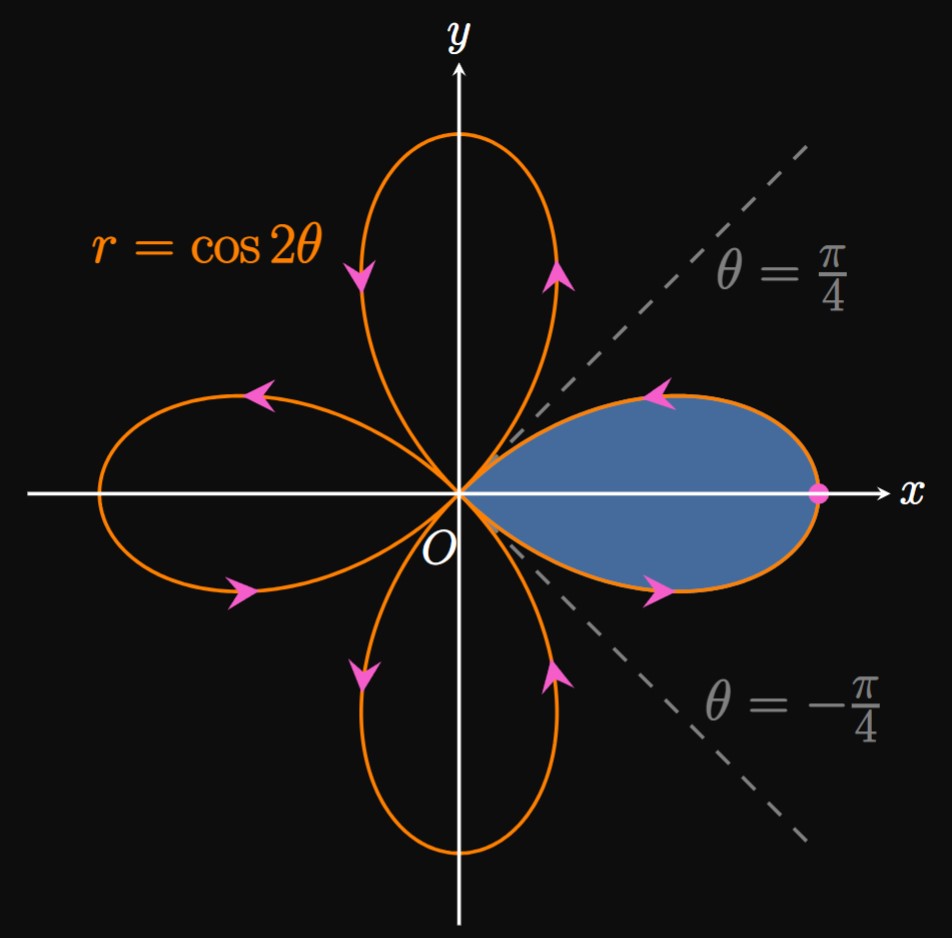
We have a strong understanding of derivatives (Chapter 2) and integrals (Chapter 4), and their countless applications. But some curves are not well-described by explicit functions \(y = f(x).\) Instead, parametric equations and polar functions extend our ability to model mathematical phenomena, such as objects in free fall. In this chapter we will introduce parametric equations (9.1) and polar functions (9.3), to which we will apply calculus concepts—finding slopes of tangents, areas, arc lengths, and surface areas of revolution.
9.2 Differentiating and Integrating Parametric Functions
Differentiating parametric functions with geometric interpretation. Finding \(\textDeriv{x}{t},\) \(\textDeriv{y}{t},\) \(\textDeriv{y}{x},\) and \(\textDerivOrder{y}{x}{2},\) where \(x\) and \(y\) are parametric functions of \(t.\)9.3 Polar Coordinates and Functions
Introduction to polar coordinates. Conversion between polar and Cartesian coordinates. Expression of polar functions as parametric functions of angle. Sketching polar graphs, with presentation of common graphs.9.4 Differentiating Polar Functions
Finding and interpreting \(\textDeriv{x}{\theta},\) \(\textDeriv{y}{\theta},\) and \(\textDeriv{r}{\theta},\) where \(r\) is a polar function of \(\theta.\)