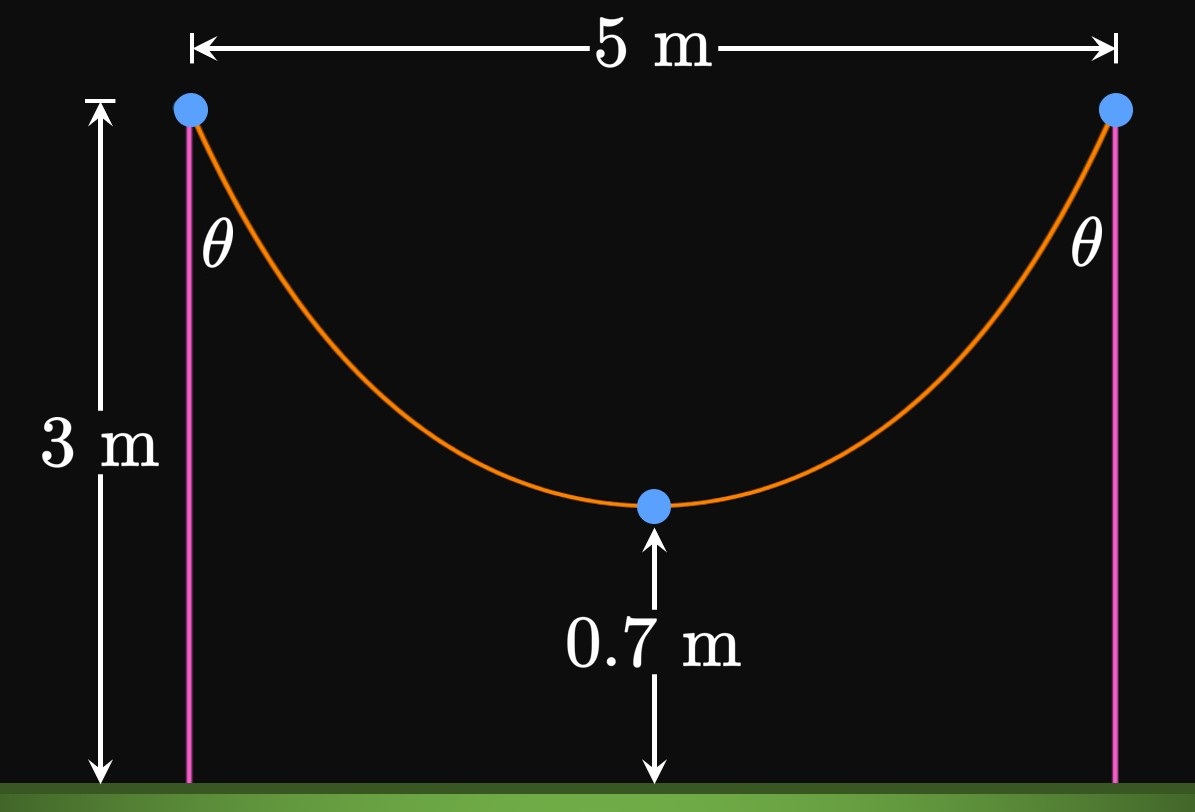
The central curve of the Gateway Arch in St. Louis, Missouri (Figure 1), was designed by
the equation
\[y = 211.49 - 20.96 \cosh 0.03291765x \cmaa \abs x \leq 91.20 \cma\]
where \(x\) and \(y\) are measured in meters
and \(y\) is the height above the ground.
Calculate the maximum height of the central arch.
At what points is the height \(80\) meters?
Calculate the slope of the arch at the points in part (b).
At some \(x,\) suppose that the slope of the tangent to \(f(x)\) equals the
slope of the tangent to \(1/f(x),\) where \(f(x) \ne 0.\)
What is this slope?
If \(f\) is differentiable at \(a,\) then calculate the following limit in terms of \(f'(a) \col\)
\[\lim_{x \to a} \frac{f(x) - f(a)}{\sqrt x - \sqrt a} \pd\]
Let \(R\) be the region in the first quadrant bounded between the coordinate axes and the
line tangent to the curve \(y = 1/x\) at any point \((a, 1/a).\)
Does the area of \(R\) depend on \(a \ques\)
Determine the area of the triangle bounded between the \(y\)-axis,
the tangent line to \(y = \ln x\) at \(x = e,\)
and the normal line to \(y = \ln x\) at \(x = e.\)
Let \(k\) be any constant and \(n\) be a positive integer.
Consider the function \(f(x) = \sin kx.\)
Write an expression for \(f^{(n)}(x)\)
when \(n\) is even and when \(n\) is odd.
(Hint: The number \(-1\) becomes positive when raised to an even power
and negative when raised to an odd power.)
A sound's decibel rating \(\beta\) is related to its intensity \(I\)
(measured in watts per square meter) by the logarithmic relationship
\[\beta = 10 \log \par{\frac{I}{10^{-12}}} \pd\]
An idling generator produces a sound of \(50\) decibels;
as the load is increased, its decibel rating increases at a constant rate of
\(3\) decibels per minute.
After \(2\) minutes,
calculate the rate at which the sound's intensity is changing.
Let \(k\) be a positive constant.
Line \(\ell\) is tangent to the curve \(f(x) = e^{kx}\)
at \(x = a\)
and strikes the \(x\)-axis at \((c, 0).\)
Calculate \(\lim_{k \to \infty} c.\)
Show that \(\lim_{k \to 0^+} c = -\infty.\)
What does this result mean geometrically?
Using differentials, approximate the amount by which \(c\) changes
as \(k\) increases from \(2\) to \(2.1.\)
With \(a\) held constant,
the value of \(k\) increases at a constant rate of \(2\) units per minute.
When \(k = 4,\) how quickly is \(c\) changing with time?
Is there a value of \(x\) at which the tangent lines to the graphs of \(f(x) = \tfrac{1}{4} x^4 + 12x,\)
\(g(x) = x^3 + 2x^2,\) and \(h(x) = 2x^2 + 27x + 2\) are all parallel to each other?
If so, then find this value of \(x.\)
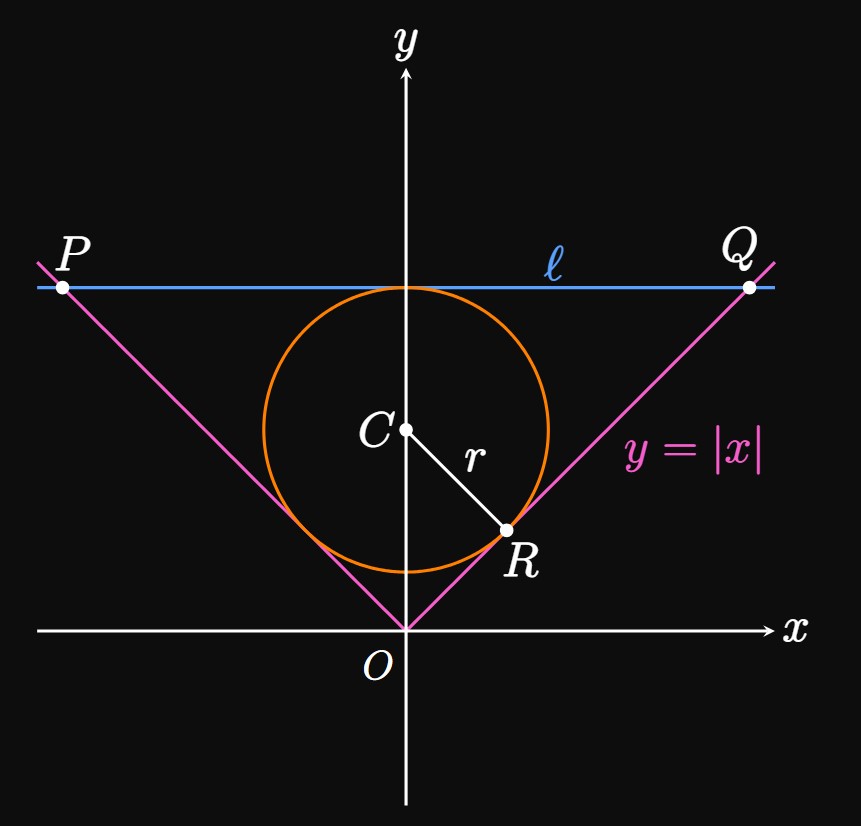
A circle of radius \(r\) is centered at point \(C\) on the \(y\)-axis and is inscribed in the triangle formed by the graph of \(y = \abs x\)
and the horizontal line \(\ell,\)
as shown in Figure 3.
In terms of \(r,\) calculate the area of \(\Delta OPQ.\)