Online Textbook Practice Tests 1500 Calculus Problems Solved About

Chapter 3 Challenge Problems Solutions

EXERCISE 1
Under the influence of damping (a gradual dissipation of energy), a vibrating object's position varies with time \(t \geq 0\) according to \[x(t) = C e^{-4t} \cos(4t - \phi) \cma\] where \(C \gt 0\) is the amplitude and \(\phi\) (phi) is the phase angle. Find \(C\) and \(\phi\) (where \(0 \leq \phi \leq 2 \pi\)) such that the object begins at rest with an initial position of \(0.1.\)

SOLUTION The function must satisfy \(x(0) = 0.1.\) In the given function \(x(t),\) substituting \(t = 0\) and equating the result to \(0.1\) show \begin{align} x(0) = Ce^{0} \cos(0 - \phi) &= 0.1 \nonum \nl C \cos(-\phi) &= 0.1 \nonum \nl \implies C &= \frac{0.1}{\cos(-\phi)} \pd \label{eq:phi-1} \end{align} Because the object starts at rest, its initial velocity is \(0\) and so \(v(0) = 0.\) Velocity is the time derivative of position, so differentiating \(x(t)\) yields the following velocity function: \[v(t) = -4C e^{-4t} \cos(4t - \phi) - 4C e^{-4t} \sin(4t - \phi) \pd\] Substituting \(t = 0\) and equating the result to \(0,\) we attain \begin{align} v(0) = -4C e^{0} \cos(0 - \phi) - 4C e^{0} \sin(0 - \phi) &= 0 \nonum \nl -4C \cos(-\phi) - 4C \sin(-\phi) &= 0 \pd \label{eq:phi-2} \end{align} Substituting \(\eqref{eq:phi-1}\) into \(\eqref{eq:phi-2}\) shows \[ \ba -4 \par{\frac{0.1}{\cos(-\phi)}} \cos(-\phi) - 4 \par{\frac{0.1}{\cos(-\phi)}} \sin(-\phi) &= 0 \nl -0.4 - 0.4 \tan(-\phi) &= 0 \nl \tan(-\phi) &= -1 \nl \implies \phi &= \boxed{\frac{\pi}{4}} \ea \] [Another solution is \(\phi = 5 \pi/4,\) but we choose \(\phi = \pi/4\) to ensure \(C \gt 0\) in Equation (1).] Substituting this result back into \(\eqref{eq:phi-1}\) produces \[C = \frac{0.1}{\cos(-\pi/4)} = \boxed{\frac{1}{5 \sqrt 2}} \approx 0.141 \pd\]
EXERCISE 2
Quadratic cost functions are highly applicable in economics. A manufacturing plant decides to model its cost using a quadratic function. The plant's overhead costs—the costs not associated with production, such as in purchasing a location—are \(\$500.\) If the total cost to produce \(100\) units is \(\$700,\) and the total cost to produce \(200\) units is \(\$950,\) then find the identity of the plant's cost function. Use this function to predict the total cost to produce \(300\) units.

SOLUTION The general form of a quadratic function is \[C(x) = ax^2 + bx + c \pd\] Our goal is to fit the parameters \(a,\) \(b,\) and \(c\) to satisfy \(C(0) = 500,\) \(C(100) = 700,\) and \(C(200) = 950.\)

Quadratic Fitting Substituting \(C(0) = 500\) shows \[ \ba C(0) = a(0)^2 + b(0) + c &= 500 \nl \implies c &= 500 \pd \ea \] Then substituting \(C(100) = 700\) yields \begin{align} C(100) = a(100)^2 + b(100) + 500 &= 700 \nonum \nl 10000a + 100b &= 200 \pd \label{eq:C-1} \end{align} Likewise, substituting \(C(200) = 950\) gives \begin{align} C(200) = a(200)^2 + b(200) + 500 &= 950 \nonum \nl 40000a + 200b &= 450 \pd \label{eq:C-2} \end{align} Multiplying \(\eqref{eq:C-1}\) by \(2\) and subtracting it from \(\eqref{eq:C-2},\) we get \[ \ba 40000a + 200b - 2(10000a + 100b) &= 450 - 2(200) \nl 20000a &= 50 \nl \implies a &= 0.0025 \pd \ea \] (See Section 0.5 to review solving systems of linear equations.) To solve for \(b,\) we substitute \(a = 0.0025\) back into either equation of the system—for example, into \(\eqref{eq:C-1} \col\) \[ \ba 10000(0.0025) + 100b &= 200 \nl \implies b &= 1.75 \pd \ea \] Hence, the identity of the cost function is \[C(x) = \boxed{0.0025x^2 + 1.75x + 500}\]

Predicted Cost The predicted cost of producing \(300\) units is \[C(300) = 0.0025(300)^2 + 1.75(300) + 500 = \boxed{\$1250}\]
EXERCISE 3
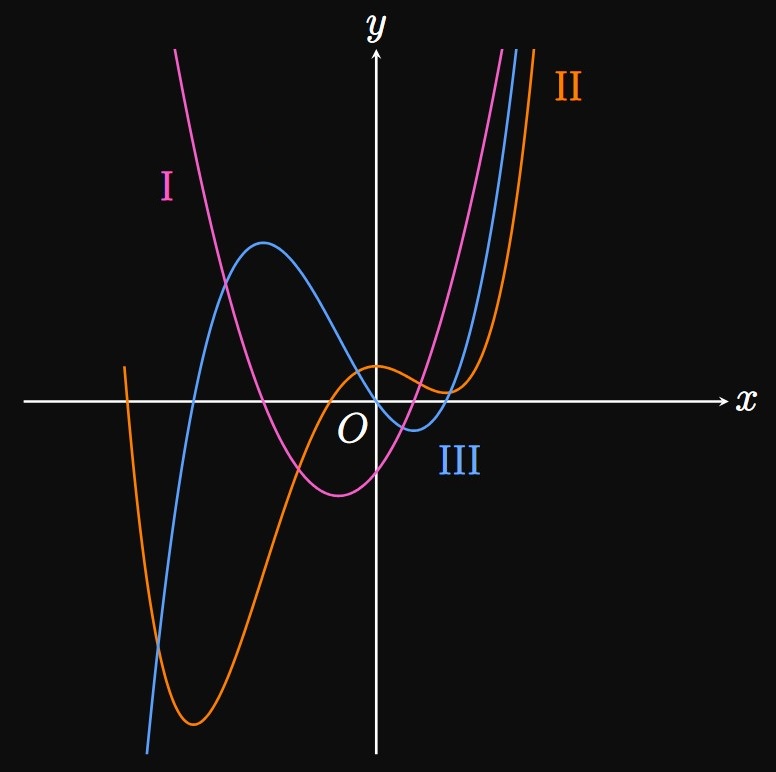
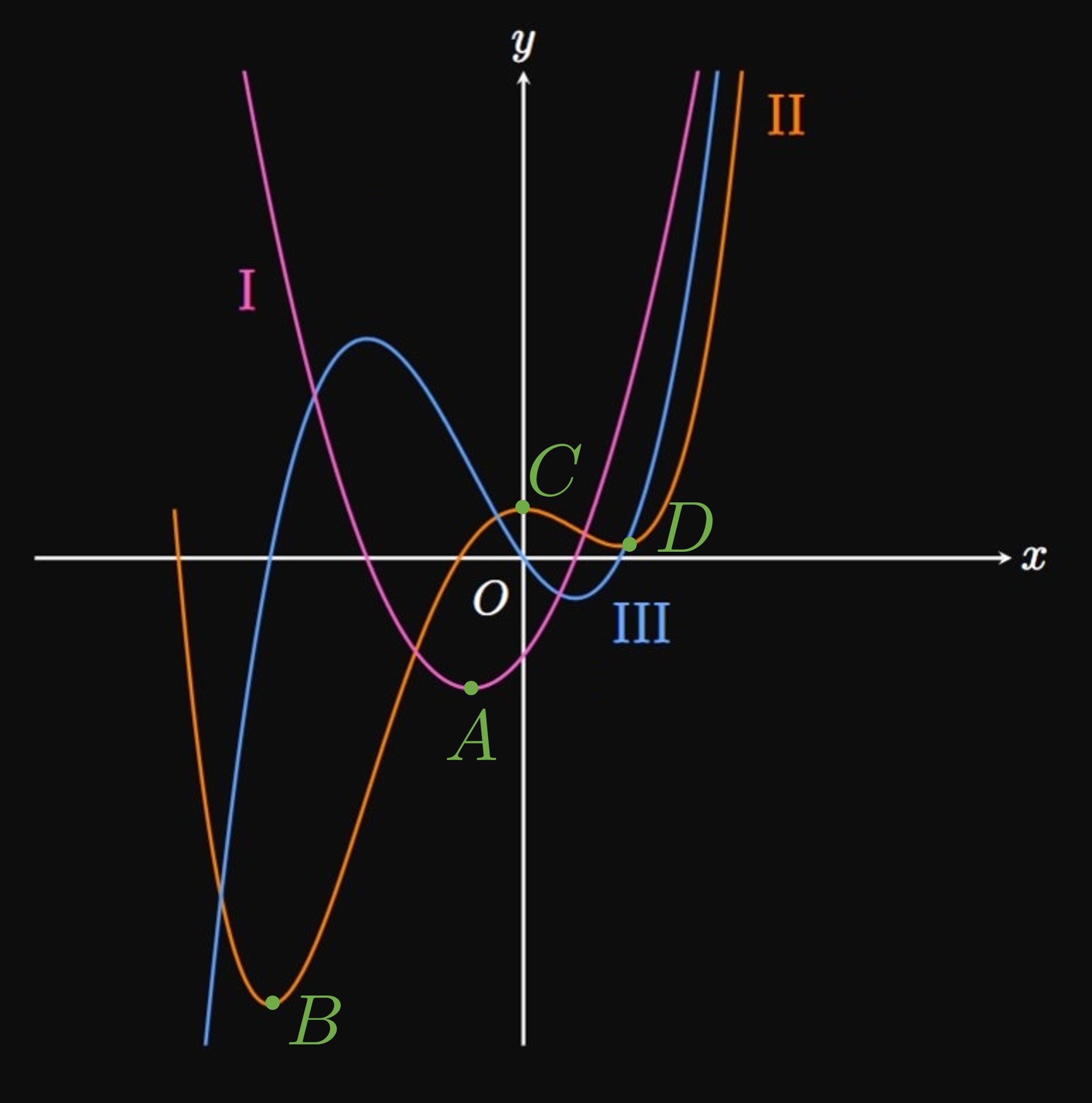
In Figure 1 determine which graph is \(f,\) which graph is \(f',\) and which graph is \(f''.\)
Figure 1

SOLUTION
To connect \(f,\) \(f',\) and \(f'',\) we consider important features—extrema, zeros, intervals of increasing or decreasing—of any one graph and see how well they align with the other two graphs. Let's begin with graph I, whose minimum is at point \(A.\) If II or III is the derivative of I, then either graph must cross the \(x\)-axis at the \(x\)-coordinate of \(A.\) But neither II nor III crosses the \(x\)-axis when graph I attains its minimum. In addition, I is decreasing for all \(x\) to the left of \(A,\) but neither II nor III is entirely negative over the same interval. Thus, II and III cannot be derivatives of I, so graph I must be \(f''.\) Now we pay attention to another graph—for example, II, which has extrema at points \(B,\) \(C,\) and \(D.\) The question is whether II is \(f\) or \(f'.\) Graph III intersects the \(x\)-axis when II attains its extrema. Graph III is positive between \(B\) and \(C,\) the region over which II is increasing, and is negative between \(C\) and \(D,\) when II is decreasing. Therefore, III must be the derivative of II. So II is \(f,\) III is \(f',\) and I is \(f''.\)
EXERCISE 4
Let \(f(x) = x^3 - 5.\) Find all the starting approximations \(x_1\) for which Newton's Method yields a second approximation of \(x_2 = 1.\)

SOLUTION Differentiating gives \(f'(x) = 3x^2.\) So Newton's Method gives \[ \ba x_2 &= x_1 - \frac{f(x_1)}{f'(x_1)} \nl &= x_1 - \frac{\par{x_1}^3 - 5}{3 \par{x_1}^2} \nl &= x_1 - \frac{x_1}{3} + \frac{5}{3 \par{x_1}^2} \nl &= \frac{2 x_1}{3} + \frac{5}{3 \par{x_1}^2} \pd \ea \] Equating \(x_2 = 1\) gives \[ \ba 1 &= \frac{2 x_1}{3} + \frac{5}{3 \par{x_1}^2} \nl 3 \par{x_1}^2 &= 2 \par{x_1}^3 + 5 \pd \ea \] By inspection, a solution to the preceding equation is \(x_1 = -1.\) Using polynomial division, we find \[2 \par{x_1}^3 - 3 \par{x_1}^2 + 5 = \par{x_1 + 1} \parbr{2 \par{x_1}^2 - 5 x_1 + 5} \pd\] The discriminant of the expression in brackets is \((-5)^2 - 4(2)(5)\) \(= -15.\) Since this value is negative, the quadratic expression has no zeros. Hence, the only solution is \(\boxed{x_1 = -1}.\)
EXERCISE 5
Let \(p\) be a twice-differentiable function. Let \(q\) be a twice-differentiable function defined by \[q(x) = \frac{2[p(x)]^3 + 4}{x^2 - 6x}\] that satisfies \(\lim_{x \to 0} q(x) = 12.\) It is known that \(\lim_{x \to 0} q(x)\) can be evaluated using L'Hôpital's Rule. Find \(p(0)\) and \(p'(0).\)

SOLUTION To apply L'Hôpital's Rule, \(\lim_{x \to 0} q(x)\) must either be in the indeterminate form \(\indZero\) or \(\indInfty.\) Since \(p\) is differentiable, \(p\) is continuous and so \(\lim_{x \to 0} p(x) = p(0).\) The denominator approaches \(0\) as \(x\) approaches \(0,\) so \(\lim_{x \to 0} q(x)\) is in the indeterminate form \(\indZero.\) Thus, \[ \ba \lim_{x \to 0} (2[p(x)]^3 + 4) &= \lim_{x \to 0} (x^2 - 6x) = 0 \nl 2p(0)^3 + 4 &= 0 \nl \implies p(0) &= \boxed{-\sqrt[3]{2}} \nl \ea \] Applying L'Hôpital's Rule gives \[ \ba \lim_{x \to 0} q(x) &= \lim_{x \to 0} \frac{6[p(x)]^2 \cdot p'(x)}{2x - 6} \nl &= \frac{6[p(0)]^2 \cdot p'(0)}{-6} \nl &= -(2)^{2/3} \cdot p'(0) \nl \ea \] We are given \(\lim_{x \to 0} q(x) = 12,\) so \[ -(2)^{2/3} \cdot p'(0) = 12 \implies p'(0) = \boxed{\frac{-12}{\sqrt[3]{4}}} \pd \]
EXERCISE 6
Determine all the solutions to the equation \[x^3 + e^x = 1 \pd\] (Hint: First find a solution by inspection; then prove that no other solutions exist.)

SOLUTION By inspection, we see \[(0)^3 + e^0 \equalsCheck 1 \cma\] so \(x = 0\) satisfies the equation. But to prove that \(x = 0\) is the only solution, we let \(f(x) = x^3 + e^x - 1\) and show that \(f\) has only one zero, \(x = 0.\) Observe that \[f'(x) = 3x^2 + e^x \gt 0 \cma\] so \(f(x)\) is increasing for all \(x.\) Hence, \(f(x) \lt f(0)\) \(= 0\) for all \(x \lt 0;\) likewise, \(f(x) \gt f(0) = 0\) for all \(x \gt 0.\) Thus, \(x = 0\) is the only root of \(f,\) meaning the equation \(x^3 + e^x = 1\) has only one solution, \(x = 0.\)
EXERCISE 7
Consider the family of functions \(k(x) = \ln(x)/x^p.\) Evaluate \(\lim_{x \to \infty} k(x)\) for
  1. \(p \gt 0\)
  2. \(p \lt 0\)

SOLUTION
  1. If \(p > 0,\) then as \(x \to \infty,\) \[\ln x \to \infty \and x^p \to \infty \pd\] Therefore, \(\lim_{x \to \infty} k(x)\) is in the indeterminate form \(\indInfty.\) We then apply L'Hôpital's Rule to find \[ \ba \lim_{x \to \infty} \frac{\ln x}{x^p} &= \lim_{x \to \infty} \frac{1/x}{px^{p - 1}} \nl &= \lim_{x \to \infty} \frac{1}{px} \nl &= \boxed{0} \ea \]

  2. Let's introduce a new variable \(q\) such that \(q = -p.\) We then have \[\lim_{x \to \infty} k(x) = \lim_{x \to \infty} x^q \ln x \cmaa q \gt 0 \pd\] As \(x \to \infty,\) \(x^q\) and \(\ln x\) both approach \(\infty,\) so their product is also \(\infty.\) Therefore, \[\lim_{x \to \infty} k(x) = \infty\] (or alternatively, \(\lim_{x \to \infty} k(x)\) does not exist).
EXERCISE 8
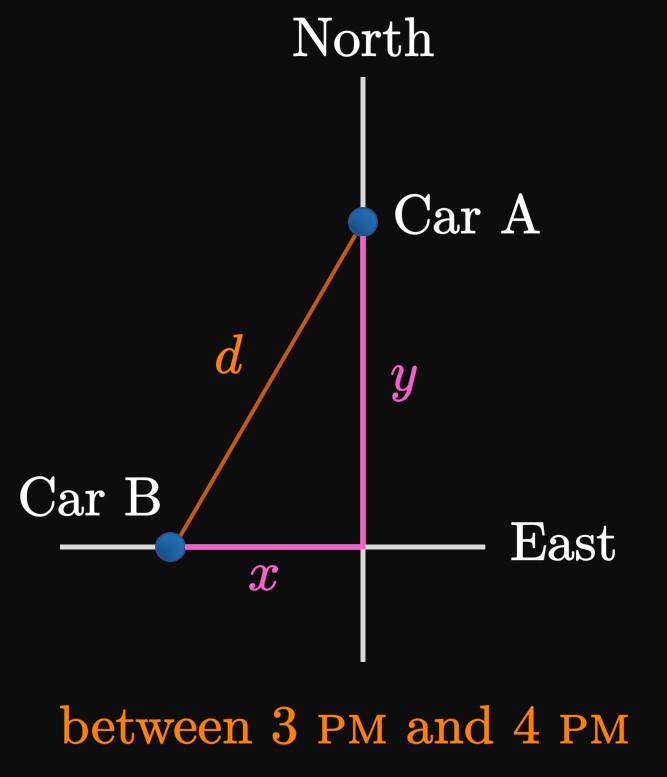
At \(3\) pm, Car A arrives at an intersection and heads due north at \(45\) miles per hour. Car B travels due east at \(55\) miles per hour and arrives at the same intersection at \(4\) pm. Each car maintains its speed and direction. Find the time after \(3\) pm during which the two cars are closest together.

SOLUTION
optimization-cars.jpg
Let \(x\) be the distance from the intersection to car B, and let \(y\) be the distance between the intersection and car A. Since car A travels at \(45\) miles per hour, its distance function with respect to time is \(y = 45t\) (where \(t\) is in hours after \(3\) pm). To write car B's distance function, we note that the car approaches the intersection one hour after 3 pm. We therefore write \(x = 55 - 55t.\) The Pythagorean Theorem gives the distance function to be \[d = \sqrt{x^2 + y^2} = \sqrt{(45t)^2 + (55 - 55t)^2} \pd\] We need to minimize \(d,\) but for convenience we choose to minimize \(d^2\) because both functions have the same critical numbers. Let \(q(t) = d^2;\) then \[q\,'(t) = 90(45t) - 110(55 - 55t) \pd\] Solving \(q\,'(t) = 0\) gives \[t = \frac{110(55)}{90(45) + 110(55)} = 0.599 \pd\] The domain of \(q\) is \(t \geq 0.\) Using a calculator, we find \(q(0) = 3025\) and \(q(0.599) = 1212.995.\) Also, \(\lim_{t \to \infty} q = \infty.\) This analysis asserts that \(t = 0.599\) must correspond to the absolute minimum of \(q\) (and, therefore, of \(d\)). Since \(0.599\) hour is \(0.599 \cdot 60 = 35.94\) minutes, we conclude that the cars are closest together at \(\boxed{\text{3:36}}\) pm.
EXERCISE 9
Let \(f\) and \(g\) be continuous functions such that \(f'(x) \gt g'(x)\) on \((a, b).\) If \(f(a) = g(a),\) then use the Mean Value Theorem to show that \(f(b) \gt g(b).\) Use this result to show that \(x \gt \sin x\) for \(0 \lt x \lt 2 \pi.\)

SOLUTION Let's define a new function \(h(x) = f(x) - g(x).\) Since \(f'(x)\) and \(g'(x)\) exist on \((a,b),\) \(h\) is differentiable on \((a,b)\) and (because \(f\) and \(g\) are continuous) \(h\) is continuous on \([a,b].\) Also, for all \(x \in (a, b),\) \[ h'(x) = f'(x) - g'(x) \gt 0 \pd \] By the Mean Value Theorem applied to \(h\) on \([a,b],\) there exists a number \(c\in(a,b)\) such that \[ h'(c) = \frac{h(b) - h(a)}{b - a}\pd \] Because \(b - a\gt 0\) and \(h'(c)\gt 0,\) we have \(h(b) - h(a)\gt 0.\) But \(h(a) = f(a) - g(a) = 0,\) so \(h(b)\gt 0,\) meaning \[ f(b) - g(b)\gt 0 \implies f(b)\gt g(b) \cma \] as desired.

Verifying the Inequality Let \(f(x) = x\) and \(g(x) = \sin x.\) Then \(f(0) = g(0) = 0.\) Also, \(f'(x) = 1\) and \(g'(x)= \cos x.\) For \(0 \lt x \lt 2\pi,\) we have \(\cos x \lt 1\) and thus \(f'(x)\gt g'(x)\) on \((0,2\pi).\) Applying the preceding result on \([0,x]\) with \(x\in(0,2\pi)\) gives \[ f(x) \gt g(x) \implies x \gt \sin x \pd \] for all \(0 \lt x \lt 2 \pi.\)

EXERCISE 10
In the movie Mean Girls (2004), Cady and her opponent face immense pressure during the tiebreaker in a mathematics competition, in which the two girls were given the limit \[\lim_{x \to 0} \frac{\ln(1 - x) - \sin x}{1 - \cos^2 x} \pd\] After her opponent's incorrect guess of \(-1,\) Cady wins the competition by blurting: The limit does not exist. Is Cady truly correct?

SOLUTION As \(x \to 0,\) both the numerator and denominator approach \(0.\) This limit is therefore in the indeterminate form \(\indZero.\) Applying L'Hôpital's Rule gives the equivalent limit \[\lim_{x \to 0} \frac{\ds -\frac{1}{1 - x} - \cos x}{-2 \cos x (-\sin x)} = \lim_{x \to 0} \frac{\ds -\frac{1}{1 - x} - \cos x}{\sin 2x} \pd\] Now as \(x \to 0,\) the numerator approaches \(-2\) and the denominator approaches \(0.\) The function therefore has a vertical asymptote at \(x = 0,\) so let's consider the behavior on either side of the asymptote: As \(x \to 0^-,\) the denominator \(\sin 2x\) is negative, so the overall sign of the fraction is \((-)/(-) = (+).\) Thus, \[ \lim_{x \to 0^-} \frac{\ds -\frac{1}{1 - x} - \cos x}{\sin 2x} = \lim_{x \to 0^-} \frac{\ln(1 - x) - \sin x}{1 - \cos^2 x} = \infty \pd\] Conversely, as \(x \to 0^+\) the denominator \(\sin 2x\) is positive, so the fraction's sign is \((-)/(+) = (-).\) We therefore say \[ \lim_{x \to 0^+} \frac{\ds -\frac{1}{1 - x} - \cos x}{\sin 2x} = \lim_{x \to 0^+} \frac{\ln(1 - x) - \sin x}{1 - \cos^2 x} = -\infty \pd\] Because the one-sided limits do not equal each other, the limit \[\lim_{x \to 0} \frac{\ln(1 - x) - \sin x}{1 - \cos^2 x}\] indeed does not exist. So Cady is correct.
EXERCISE 11
Figure 2
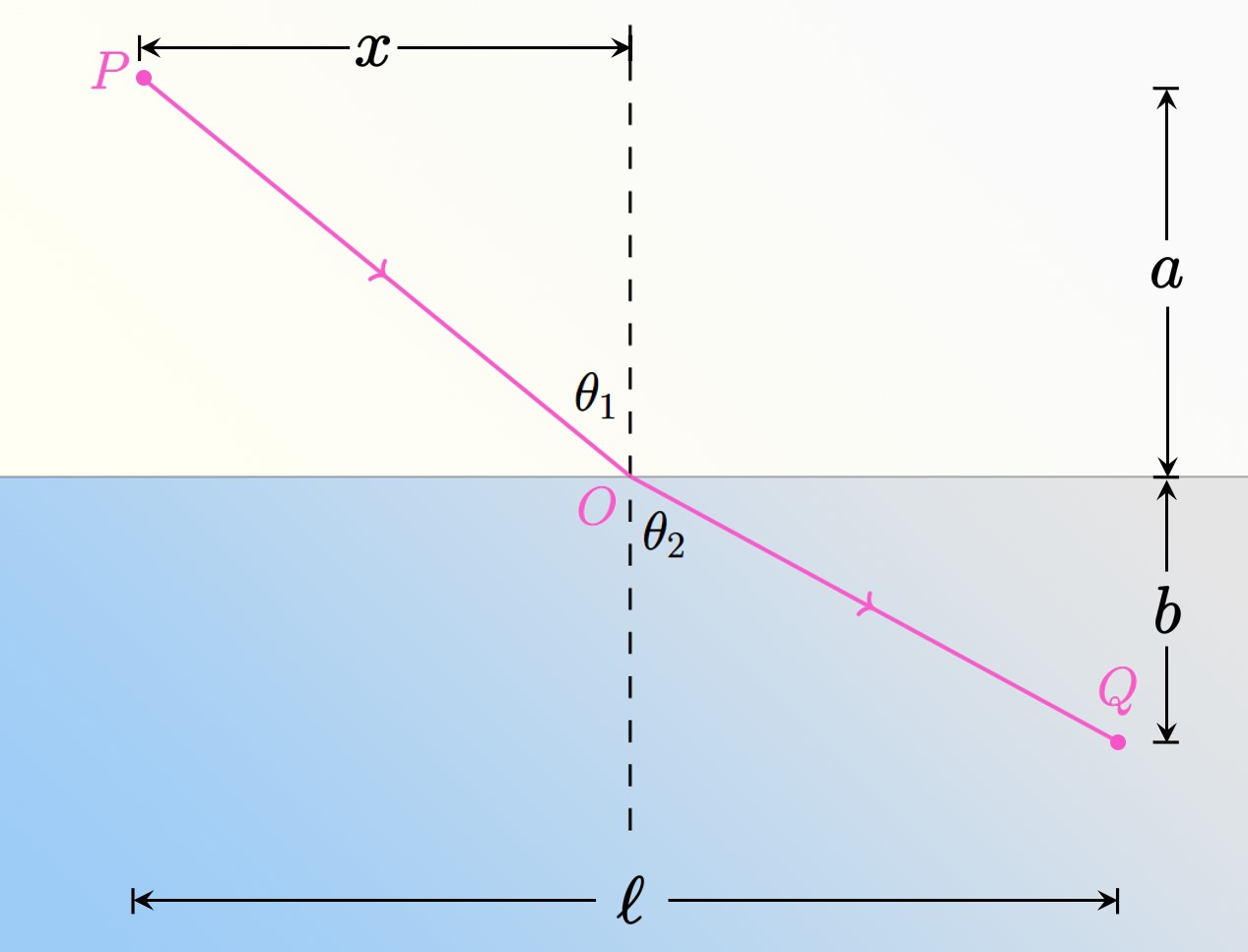
In Figure 2, a ray of light starts in the air at point \(P,\) is refracted into a medium of water at point \(O,\) and travels to point \(Q.\) Fermat's Principle states that the light ray follows the fastest route to point \(Q.\) Let \(v_1\) be the light's speed in air and \(v_2\) be its speed in water. Show that \[\frac{\sin \theta_1}{v_1} = \frac{\sin \theta_2}{v_2} \pd\] This formula is Snell's Law, a fundamental equation in the study of optics.

SOLUTION Recall that \(\text{time} = \text{distance}/\text{speed}.\) When the light ray travels from \(P\) to \(O,\) the time is \[t_1 = \frac{\sqrt{x^2 + a^2}}{v_1} \pd\] Likewise, traveling from \(O\) to \(Q\) takes time \[t_2 = \frac{\sqrt{(\ell - x)^2 + b^2}}{v_2} \pd\] Then the total time is \[ \ba T &= t_1 + t_2 \nl &= \frac{\sqrt{x^2 + a^2}}{v_1} + \frac{\sqrt{(\ell - x)^2 + b^2}}{v_2} \pd \ea \] Differentiating, we obtain \begin{equation} T'(x) = \frac{x}{v_1 \sqrt{x^2 + a^2}} - \frac{\ell - x}{v_2 \sqrt{(\ell - x)^2 + b^2}} \pd \label{eq:snell} \end{equation} We see \[\sin \theta_1 = \frac{x}{\sqrt{x^2 + a^2}} \qquad \sin \theta_2 = \frac{\ell - x}{\sqrt{(\ell - x)^2 + b^2}} \pd \] Then \(\eqRefer{eq:snell}\) becomes \[T'(x) = \frac{\sin \theta_1}{v_1} - \frac{\sin \theta_2}{v_2} \pd\] Solving \(T'(x) = 0\) then yields \[\frac{\sin \theta_1}{v_1} = \frac{\sin \theta_2}{v_2} \cma\] as requested. We assume that this situation confers the absolute minimum of \(T.\)
EXERCISE 12
Determine all the starting approximations \(x_1\) in \([0, 1]\) for which Newton's Method fails to converge to the zero of \(f(x) = x^3 + 2.\)

SOLUTION Note that \(f'(x) = 3x^2.\) The graph of \(f\) therefore has a horizontal tangent when \(f'(x) = 0,\) that is, at \(x = 0.\) So \(x_1 = 0\) causes Newton's Method to fail because the tangent line never strikes the \(x\)-axis. For other values of \(x_1,\) the iterative formula is \[ \ba x_2 &= x_1 - \frac{f(x_1)}{f'(x_1)} \nl &= x_1 - \frac{\par{x_1}^3 + 2}{3 \par{x_1}^2} \nl &= x_1 - \frac{x_1}{3} - \frac{2}{3 \par{x_1}^2} \nl &= \frac{2 x_1}{3} - \frac{2}{3 \par{x_1}^2} \pd \ea \] Newton's Method fails to converge if it yields \(x_2 = 0,\) the location of the horizontal tangent. Solving shows \[ \ba 0 &= \frac{2 x_1}{3} - \frac{2}{3 \par{x_1}^2} \nl 0 &= \par{x_1}^3 - 1 \nl \implies x_1 &= 1 \pd \ea \] Newton's Method also fails if it yields \(x_2 = 1,\) since the following approximation would be \(x_3 = 0.\) The function \(2x_1/3 - 2/[3(x_1)^2]\) is increasing for positive \(x_1,\) so the solution to \[ 1 = \frac{2 x_1}{3} - \frac{2}{3 \par{x_1}^2} \] satisfies \(x_1 \gt 1\) (the solution is \(x_1 \approx 1.806\)). Newton's Method also fails if it yields \(x_2 \approx 1.806\) (because then \(x_3 = 1\) and \(x_4 = 0\)), yet the solution to \[ 1.806 = \frac{2 x_1}{3} - \frac{2}{3 \par{x_1}^2} \] satisfies \(x_1 \gt 1.806\) (the solution is \(x_1 \approx 2.834\)). This pattern is repeating—subsequent defective values of \(x_1\) are all outside \([0, 1].\) But inside \([0, 1],\) there are no other cases in which Newton's Method fails. Note that \(f'\) is nonnegative, so \(f\) is always increasing. Hence, \(f\) has only one zero, and Newton's Method cannot converge to another zero. Additionally, in Example 3.8-3 Newton's Method fails because the approximations bounce back and forth. But \(f\) is increasing, so the tangent lines always have nonnegative slope, thus avoiding the bouncing issue. Hence, the defective starting approximations \(x_1 \in [0, 1]\) are \(\boxed{x_1 = 0}\) and \(\boxed{x_1 = 1}.\)