The trigonometric substitution \(x + 1 = c \sec \theta,\)
where \(c \ne 0,\)
can be used to evaluate
\[\int_0^2 \frac{(x + 1)^2 - c^2}{x + 1} \di x \pd\]
But for some values of \(c,\)
you cannot proceed to convert the bounds to be in terms of \(\theta.\)
Find these values of \(c.\)
SOLUTION
In performing the substitution \(x + 1 = c \sec \theta,\)
we obtain the following bound changes.
Lower Bound
When \(x = 0,\)
we have \(1 = c \sec \theta,\)
or \(\sec \theta = 1/c.\)
Upper Bound
When \(x = 2,\)
we have \(3 = c \sec \theta,\)
or \(\sec \theta = 3/c.\)
But the range of secant is \((-\infty, -1] \cup [1, \infty).\)
Thus, we must avoid \(1/c\) or \(3/c\) lying within \((-1, 1).\)
For the lower bound \(x = 0,\)
we have
\[\abs{\frac{1}{c}} \lt 1 \iffArrow \abs{c} \gt 1 \pd\]
Additionally, for the upper bound \(x = 2,\)
\[\abs{\frac{3}{c}} \lt 1 \iffArrow \abs{c} \gt 3 \pd\]
The intersection of the sets \(\{c \mid \abs c \gt 1\}\)
and \(\{c \mid \abs c \gt 3\}\) is
\[\boxed{(-\infty, -1) \cup (1, \infty)}\]
In this case, we must antidifferentiate the integrand and return to working with \(x\)—not \(\theta.\)
EXERCISE 2
For what values of \(q\) does \(\int_0^1 \dd x/x^q\) converge?
SOLUTION
The integral is
\[
\ba
\lim_{t \to 0^+} \int_t^1 x^{-q} \di x
&= \lim_{t \to 0^+} \frac{x^{1 - q}}{1 - q} \intEval_t^1 \nl
&= \frac{1}{1 - q} - \lim_{t \to 0^+} \frac{t^{1 - q}}{1 - q} \pd
\ea
\]
If \(q \lt 1,\) then \(1 - q\) is positive
and so \(t^{1 - q}/(1 - q) \to 0\) as \(t \to 0^+.\)
Then the integral converges.
But if \(q \gt 1,\) then \(1 - q\) is negative
and so \(t^{1 - q}/(1 - q) \to \infty\) as \(t \to 0^+,\)
meaning the integral diverges.
And if \(q = 1,\) then the integral becomes
\[
\ba
\lim_{t \to 0^+} \ln x \intEval_t^1
&= 0 - \lim_{t \to 0^+} \ln t \nl
&= \infty \pd
\ea
\]
Accordingly, \(\int_0^1 \dd x/x^q\) converges for \(\boxed{q \lt 1}.\)
EXERCISE 3
For
\[\ds \int \frac{\tan^3 x + \tan x}{6 \tan^2 x - 2} \di x\]
evaluate the integral.
SOLUTION
By factoring the numerator,
the integral becomes
\[
\int \frac{\tan x (\tan^2 x + 1)}{6 \tan^2 x - 2} \di x
= \int \frac{\tan x \sec^2 x}{6 \tan^2 x - 2} \di x \pd
\]
Substituting \(u = 6 \tan^2 x - 2,\)
we obtain \(\dd u = 12 \tan x \sec^2 x \di x\)
and so the integral becomes
\[
\ba
\int \frac{1}{12 u} \di u &= \tfrac{1}{12} \ln \abs u + C \nl
&= \boxed{\tfrac{1}{12} \ln \abs{6 \tan^2 x - 2} + C}
\ea
\]
EXERCISE 4
For
\[\ds \int \frac{1}{\sin^6 x + \cos^6 x} \di x\]
evaluate the integral.
SOLUTION
Multiplying the numerator and denominator each by \(\sec^6 x\) yields
\[\int \frac{\sec^6 x}{\tan^6 x + 1} \di x \pd\]
Since the power of secant is even,
we can conserve an extra \(\sec^2 x\) factor, similar to the strategy in
Section 6.2.
Because \(\sec^2 x\) \(= \tan^2 x + 1,\)
we have
\[\int \frac{\sec^4 x \sec^2 x}{\tan^6 x + 1} \di x = \int \frac{(\tan^2 x + 1)^2 \sec^2 x}{\tan^6 x + 1} \di x \pd\]
Substituting \(u = \tan x,\) we obtain \(\dd u = \sec^2 x \di x\) and so the integral becomes
\[
\ba
\int \frac{(u^2 + 1)^2}{u^6 + 1} \di u &= \int \frac{(u^2 + 1)^2}{(u^2 + 1)(u^4 - u^2 + 1)} \di u \nl
&= \int \frac{u^2 + 1}{u^4 - u^2 + 1} \di u \pd
\ea
\]
Dividing the numerator and denominator each by \(u^2\) yields
\[
\int \frac{1 + \dfrac{1}{\strut u^2}}{u^2 - 1 + \dfrac{\strut 1}{u^2}} \di u
= \int \frac{1 + \dfrac{1}{\strut u^2}}{\par{u - \dfrac{1}{u}}^2 + 1} \di u \pd
\]
Letting \(v = u - 1/u,\) we get \(\dd v = (1 + 1/u^2) \di u\)
and thus
\[
\ba
\int \frac{1}{v^2 + 1} \di v &= \atan v + C \nl
&= \atan \par{u - \frac{1}{u}} + C \nl
&= \atan \par{\tan x - \frac{1}{\tan x}} + C \nl
&= \boxed{\atan \par{\tan x - \cot x} + C}
\ea
\]
EXERCISE 5
For
\[\ds \int \par{\cos^4 x - \sin^4 x} e^{\sqrt x} \sec 2x \sqrt x \di x\]
evaluate the integral.
SOLUTION
While it appears menacing, the integrand can be drastically simplified.
Note that
\[
\ba
\cos^4 x - \sin^4 x &= (\cos^2 x + \sin^2 x)(\cos^2 x - \sin^2 x) \nl
&= \cos^2 x - \sin^2 x \nl
&= \cos 2x \pd
\ea
\]
Thus, the integral becomes
\[\int \cos 2x e^{\sqrt x} \sec 2x \sqrt x \di x = \int \sqrt x \, e^{\sqrt x} \di x \pd\]
Substituting \(t = \sqrt x,\)
we get \(\dd t = 1/(2 \sqrt x) \di x\)
\(= 1/2t \di x.\)
Accordingly, \(\dd x = 2t \di t\)
and so the integral becomes
\[\int t e^t (2t) \di t = \int 2t^2 e^t \di t \pd\]
Performing Integration by Parts
(Section 6.1)
with
\[
\baat{2}
u &= 2t^2 \lspace &\dd v &= e^t \di t \nl
\dd u &= 4t \di t \lspace &v &= e^t
\eaat
\]
yields
\[2 t^2 e^t - \int 4t e^t \di t \pd\]
We use Integration by Parts again with
\[
\baat{2}
u &= 4t \lspace &\dd v &= e^t \di t \nl
\dd u &= 4 \di t \lspace &v &= e^t \cma
\eaat
\]
obtaining
\[
\ba
2t^2 e^t - \par{4t e^t - \int 4 e^t \di t}
&= 2t^2 e^t - \par{4t e^t - 4 e^t} + C \nl
&= 2t^2 e^t - 4t e^t + 4e^t + C \nl
&= \boxed{2x e^{\sqrt x} - 4 \sqrt x e^{\sqrt x} + 4 e^{\sqrt x} + C}
\ea
\]
Letting \(n\) be a positive integer
greater than \(2,\)
prove that
\[\int \sec^n x \di x = \frac{\sec^{n - 2} x \tan x}{n - 1} + \frac{n - 2}{n - 1} \int \sec^{n - 2} x \di x \pd\]
(This formula is the
power-reduction formula for secant.)
SOLUTION
Since \(\sec^2 x\) is easy to integrate,
let's break up the integral as
\[\int \sec^n x \di x = \int \sec^{n - 2} x \sec^2 x \di x\]
and perform Integration by Parts.
We choose
\[
\baat{2}
u &= \sec^{n - 2} x \lspace &\dd v &= \sec^2 x \di x \nl
\dd u &= (n - 2) \sec^{n - 3} x (\sec x \tan x) \di x \lspace &v &= \tan x \pd \nl
&= (n - 2) \sec^{n - 2} x \tan x \di x
\eaat
\]
So we have
\[
\ba
\int \sec^n x \di x
&= \sec^{n - 2} x \tan x - (n - 2) \int \sec^{n - 2} x \tan^2 x \di x \nl
&= \sec^{n - 2} x \tan x - (n - 2) \int \sec^{n - 2} x (\sec^2 x - 1) \di x \nl
&= \sec^{n - 2} x \tan x - (n - 2) \int \sec^n x \di x + (n - 2) \int \sec^{n - 2} x \di x \pd
\ea
\]
Adding \(\int \sec^{n - 2} x \di x\) to both sides yields
\[
\ba
(n - 1) \int \sec^n x \di x &= \sec^{n - 2} x \tan x + (n - 2) \int \sec^{n - 2} x \di x \nl
\implies \int \sec^n x \di x &= \frac{\sec^{n - 2} x \tan x}{n - 1} + \frac{n - 2}{n - 1} \int \sec^{n - 2} x \di x \cma
\ea
\]
as requested.
EXERCISE 9
For what values of \(c\) does \(\int_c^{2c} \dd x/\par{x^2 - 8x + 16}\) diverge?
SOLUTION
By factoring the denominator, the integral becomes
\[\int_c^{2c} \frac{1}{(x - 4)^2} \di x \pd\]
The graph of \(y = 1/(x - 4)^2\) has a vertical asymptote at \(x = 4.\)
For any \(a \lt 4 \lt b,\) observe that
\[
\ba
\int_4^b \frac{1}{(x - 4)^2} \di x
&= \lim_{t \to 4^+} \int_t^b \frac{1}{(x - 4)^2} \di x \nl
&= \lim_{t \to 4^+} \par{-\frac{1}{x - 4}} \intEval_t^b \nl
&= \lim_{t \to 4^+} \par{\frac{1}{t - 4} - \frac{1}{b - 4}} \nl
&= \infty \pd
\ea
\]
Also,
\[
\ba
\int_a^4 \frac{1}{(x - 4)^2} \di x
&= \lim_{t \to 4^-} \int_a^t \frac{1}{(x - 4)^2} \di x \nl
&= \lim_{t \to 4^-} \par{-\frac{1}{x - 4}} \intEval_a^t \nl
&= \lim_{t \to 4^-} \par{\frac{1}{a - 4} - \frac{1}{t - 4}} \nl
&= \infty \pd
\ea
\]
Thus, any integral whose bounds run through the vertical asymptote is divergent.
Hence, the values of \(c\) must cross \(x = 4,\)
meaning \(c \leq 4 \leq 2c.\)
With \(4 \leq 2c,\) we have \(c \geq 2.\)
Thus, we have
\[
\ba
\{c \mid c \geq 2 \text{ and } c \leq 4\} = \boxed{[2, 4]}
\ea
\]
EXERCISE 10
By factoring the denominator as \(x (x^{2023} - 1)\) and splitting the integrand into two fractions,
evaluate
\[\int \frac{1}{x^{2024} - x} \di x \pd\]
SOLUTION
Observe that
\[\frac{1}{x^{2024} - x} = \frac{-1}{x} + \frac{x^{2022}}{x^{2023} - 1} \pd\]
By substituting \(u = x^{2023} - 1,\) we get \(\dd u = 2023 x^{2022} \di x;\)
thus, we see
\[
\ba
\int \frac{x^{2022}}{x^{2023} - 1} \di x &= \int \frac{1}{2023 u} \di u \nl
&= \tfrac{1}{2023} \ln \abs u + C \nl
&= \tfrac{1}{2023} \ln \abs{x^{2023} - 1} + C \pd
\ea
\]
Hence, we have
\[
\int \frac{1}{x^{2024} - x} \di x
= \boxed{-\ln \abs x + \tfrac{1}{2023} \ln \abs{x^{2023} - 1} + C}
\]
EXERCISE 11
The convolution operation is defined as
\[(u \circledast v)(x) = \int_{-\infty}^\infty u(y) v(x - y) \di y \pd\]
By using the change of variable \(t = x - y,\) show that the convolution operation is commutative; that is,
\[(u \circledast v)(x) = (v \circledast u)(x) \pd\]
Assume \(u\) and \(v\) are integrable functions such that the improper integral converges.
SOLUTION
Note that \(y\) is simply a dummy variable; the convolutions of \(u\) and \(v\) are functions of \(x.\)
Our goal is to show that \((u \circledast v)(x) = (v \circledast u)(x),\)
or
\[
\ba
\underbrace{\int_{-\infty}^\infty u(y) v(x - y) \di y}_{(u \circledast v)(x)} &= \int_{-\infty}^\infty v(y) u(x - y) \di y \nl
&= \int_{-\infty}^\infty u(x - y) v(y) \di y \pd
\ea
\]
We use a change of variable \(t = x - y.\)
Then \(y = x - t\) and \(\dd y = -\dd t.\)
In addition, when \(y = -\infty,\) \(t = \infty;\) when \(y = \infty,\) \(t = -\infty.\)
Hence,
\[
\ba
\underbrace{\int_{-\infty}^\infty u(y) v(x - y) \di y}_{(u \circledast v)(x)} &= \int_\infty^{-\infty} u(x - t) v(t) (-1) \di t \nl
&= \int_{-\infty}^{\infty} u(x - t) v(t) \di t \nl
&= \int_{-\infty}^\infty v(t) u(x - t) \di t \nl
&= (v \circledast u)(x) \cma
\ea
\]
where the last step is true because \(t\) is simply a dummy variable.
Hence,
\[
(u \circledast v)(x) = (v \circledast u)(x) \cma
\]
so convolution is commutative.
EXERCISE 12
For any integer \(n \geq 1,\)
develop a formula for \(\int x^n e^x \di x.\)
SOLUTION
Let's perform Integration by Parts with
\[
\baat{2}
u &= x^n \lspace &\dd v &= e^x \di x \nl
\dd u &= n x^{n - 1} \di x \lspace &v &= e^x \pd
\eaat
\]
Doing so gives
\[\int x^n e^x \di x = x^n e^x - \int n x^{n - 1} e^x \di x \pd\]
Performing Integration by Parts again with
\[
\baat{2}
u &= n x^{n - 1} \lspace &\dd v &= e^x \di x \nl
\dd u &= n (n - 1) x^{n - 2} \di x \lspace &v &= e^x
\eaat
\]
shows
\[\int x^n e^x \di x = x^n e^x - n x^{n - 1} e^x + \int n (n - 1) x^{n - 2} e^x \di x \pd\]
Continuing this pattern, we have
\[
\ba
\int x^n e^x \di x &= \small x^n e^x - n x^{n - 1} e^x + n (n - 1) (n - 2) x^{n - 2} e^x - n (n - 1)(n - 2)(n - 3) x^{n - 3} e^x + \cdots \nl
&= \boxed{\sum_{i = 0}^n (-1)^i \, x^{n - i} \, e^x \frac{n!}{(n - i)!}}
\ea
\]
Note that \(0! = 1.\)
EXERCISE 13
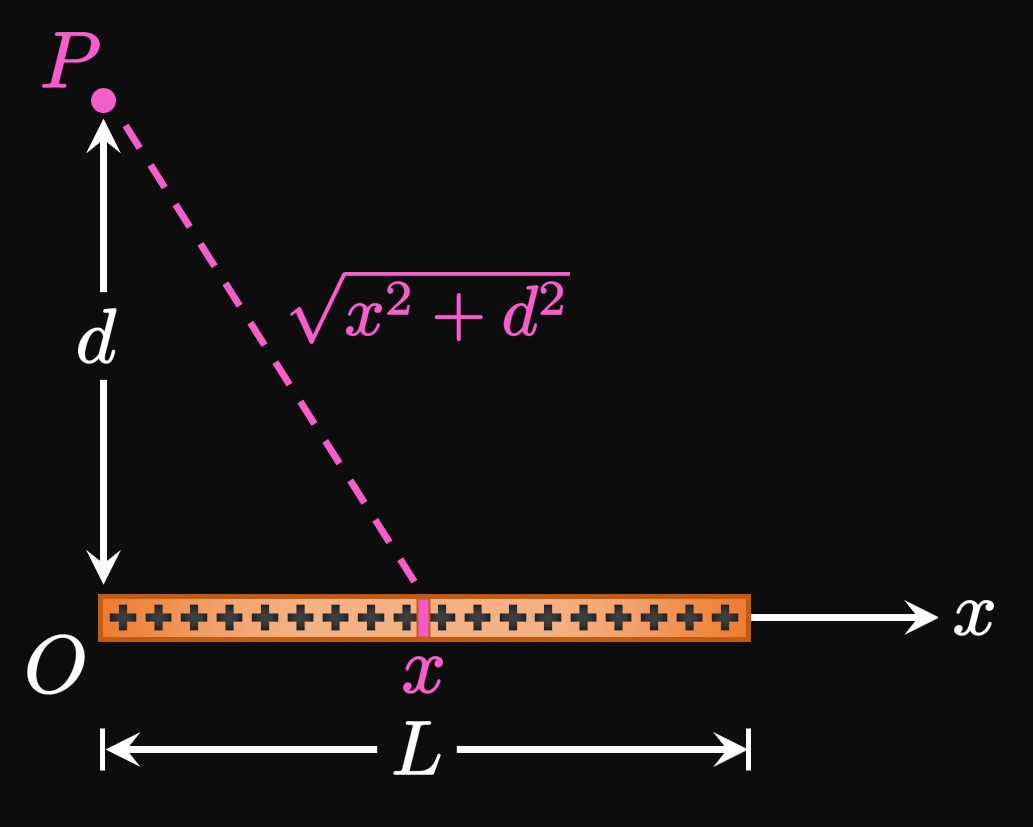
A uniform, long, positively charged rod of length \(L\) holds a charge \(Q.\)
Let the \(x\)-axis be positioned through the rod spanning from \(x = 0\) to \(x = L.\)
Point \(P\) is located a distance \(d\) above the left end of the rod.
(See Figure 1.)
Let \(V\) be the electric potential at \(P.\)
At any \(0 \leq x \leq L,\)
it follows that
\[\frac{\dd V}{\dd x} = \frac{k Q}{L \sqrt{x^2 + d^2}} \cma\]
where \(k\) is a constant.
The total electric potential at \(P\) is given by integrating the right expression
from \(x = 0\) to \(x = L.\)
Determine this electric potential, \(V.\)
SOLUTION
The integral to evaluate is
\[
\ba
V &= \int_0^L \frac{kQ}{L \sqrt{x^2 + d^2}} \di x \nl
&= \frac{kQ}{L} \int_0^L \frac{1}{\sqrt{x^2 + d^2}} \di x \pd
\ea
\]
We immediately substitute \(x = d \tan \theta,\)
\(-\pi/2 \lt \theta \lt \pi/2;\)
then \(\dd x = d \sec^2 \theta \di \theta.\)
We now change the bounds.
Lower Bound
When \(x = 0,\)
we have \(0 = d \tan \theta,\)
so \(\theta = 0.\)
Upper Bound
When \(x = L,\)
we have \(L = d \tan \theta,\)
so \(\theta = \atan(L/d).\)
For convenience, let \(\beta = \atan(L/d).\)
Since \(L\) and \(d\) are both positive,
\(\beta = \atan(L/d)\) must be positive and less than \(\pi/2.\)
Accordingly, secant is positive on \([0, \beta].\)
Hence, we obtain
\[
\ba
V &= \frac{kQ}{L} \int_0^\beta \frac{1}{\sqrt{d^2 \tan^2 \theta + d^2}} (d \sec^2 \theta) \di \theta \nl
&= \frac{kQ}{L} \int_0^\beta \frac{d \sec^2 \theta}{d \abs{\sec \theta}} \di \theta \nl
&= \frac{kQ}{L} \int_0^\beta \sec \theta \di \theta \nl
&= \frac{kQ}{L} \ln \abs{\sec \theta + \tan \theta} \intEval_0^\beta \nl
&= \frac{kQ}{L} \ln \abs{\sec \beta + \tan \beta} - 0 \pd
\ea
\]
But we defined \(\tan \beta = L/d,\)
so by the Pythagorean identity we have
\[\sec \beta = \sqrt{\par{\frac{L}{d}}^2 + 1} = \sqrt{\frac{L^2 + d^2}{d^2}} = \frac{\sqrt{L^2 + d^2}}{d} \cma\]
where the positive solution is appropriate.
Substituting expressions yields
\[
\ba
V &= \frac{kQ}{L} \ln \abs{\frac{\sqrt{L^2 + d^2}}{d} + \frac{L}{d}} \nl
&= \boxed{\frac{kQ}{L} \ln \abs{\frac{L + \sqrt{L^2 + d^2}}{d}}}
\ea
\]
EXERCISE 14
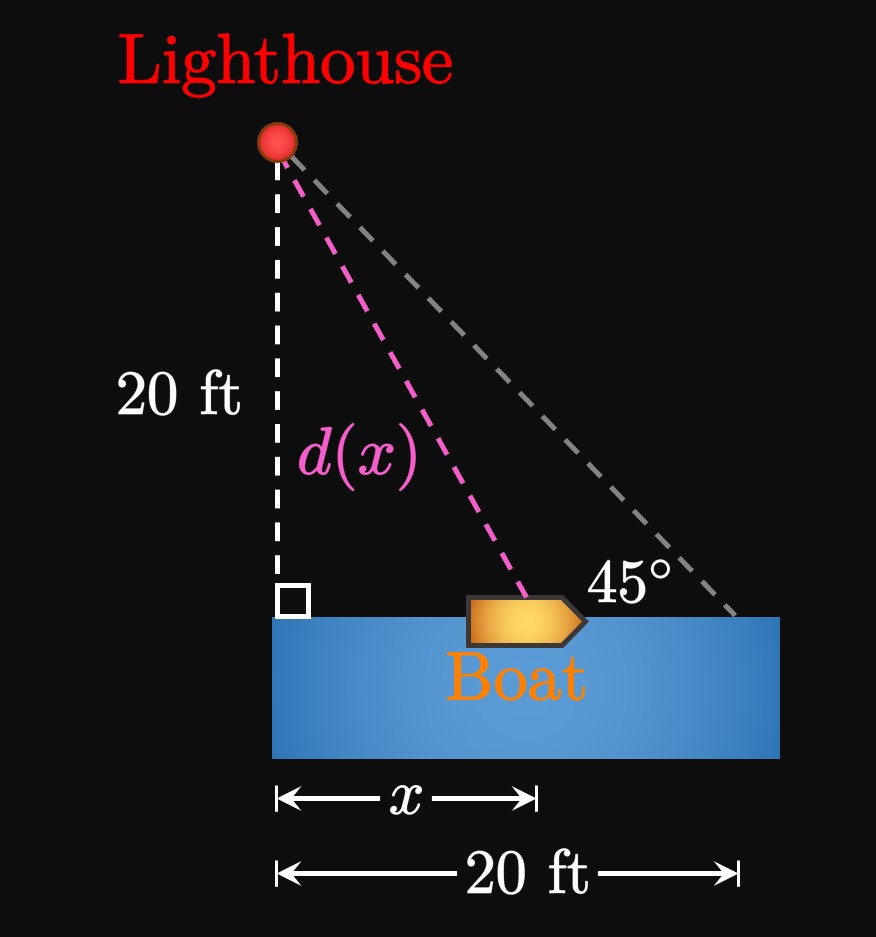
A boat initially lies \(20\) feet below a lighthouse.
The boat then sails along the flat ocean until the angle of elevation to the lighthouse is \(45 \degree.\)
During the boat's journey, what is its average distance to the lighthouse?
How far has the boat sailed when it attains this average distance?
SOLUTION
The vertical distance between the boat and lighthouse is \(20 \un{ft}.\)
Let \(x\) be the horizontal distance between the boat and lighthouse.
Then by the Pythagorean Theorem,
the distance between the boat and lighthouse is
\[d(x) = \sqrt{x^2 + 20^2} = \sqrt{x^2 + 400} \pd\]
Once the angle of elevation becomes \(45 \degree,\)
the horizontal distance is \(20 \un{ft}.\)
Hence, the boat's journey is modeled by \(0 \leq x \leq 20,\)
on which the average value of \(d\) (Section 5.6) is
\[
\ba
\avg d &= \frac{1}{20 - 0} \int_0^{20} d(x) \di x \nl
&= \tfrac{1}{20} \int_0^{20} \sqrt{x^2 + 400} \di x \pd
\ea
\]
To evaluate the integral, we substitute \(x = 20 \tan \theta;\)
then \(\dd x = 20 \sec^2 \theta \di \theta.\)
When \(x = 0,\) \(\theta = 0;\) when \(x = 20,\) \(\theta = \pi/4.\)
We therefore have
\[
\ba
\avg d &= \tfrac{1}{20} \int_0^{\pi/4} \sqrt{400 \tan^2 \theta + 400} \, (20 \sec^2 \theta) \di \theta \nl
&= \int_0^{\pi/4} \sqrt{400 \sec^2 \theta} \, \sec^2 \theta \di \theta \nl
&= \int_0^{\pi/4} \abs{20 \sec \theta} \sec^2 \theta \di \theta \nl
&= 20 \int_0^{\pi/4} \sec^3 \theta \di \theta \pd
\ea
\]
The result of Example 6.2-12 yields
\[
\ba
\avg d &= 20 \par{\tfrac{1}{2} \sec \theta \tan \theta + \tfrac{1}{2} \ln \abs{\sec \theta + \tan \theta}} \intEval_0^{\pi/4} \nl
&= 10 \par{\sqrt 2} (1) + 10 \ln \abs{\sqrt 2 + 1} \nl
&= \boxed{10 \sqrt 2 + 10 \ln \par{\sqrt 2 + 1}} \approx 22.956 \un{ft} \pd
\ea
\]
Since \(d\) is continuous on \([0, 20],\)
the Mean Value Theorem for Integrals guarantees
a value \(c \in [0, 20]\) such that \(d(c) = \avg d.\)
Solving gives
\[
\ba
\sqrt{c^2 + 400} &= 10 \sqrt 2 + 10 \ln \par{\sqrt 2 + 1} \nl
\implies c &= \boxed{\sqrt{\parbr{10 \sqrt 2 + 10 \ln \par{\sqrt 2 + 1}}^2 - 400}} \approx 11.268 \un{ft} \pd
\ea
\]
Thus, after the boat has sailed \(11.268 \un{ft},\)
it reaches its average distance \(\avg d\) to the lighthouse.
EXERCISE 15
The gamma function enables factorials to be computed for all real numbers,
and it is defined by the improper integral
\[\Gamma(z) = \int_0^\infty e^{-t} \, t^{z - 1} \di t \cma\]
which converges for any \(z > 0.\)
This function appears often in applications such as probability and physics.
For positive integers \(n,\) the gamma function satisfies \(\Gamma(n) = (n - 1)! \, .\)
Verify that \(\Gamma(4) = 3! \,.\)
As an extension of the identity \((n + 1)! = (n + 1) \, n! \, ,\)
show that \(\Gamma(n + 1) = n \Gamma(n)\) for any \(n > 0.\)
Using the gamma function, write an improper integral that equals \(\par{\tfrac{1}{3}} ! \, .\)
Then use a calculator to approximate \(\par{\tfrac{1}{3}} !\) to three decimal places.
SOLUTION
By the definition of the gamma function,
\[\Gamma(4) = \int_0^\infty t^3 \, e^{-t} \di t \pd \]
Rewriting the improper integral as a limit gives
\[\Gamma(4) = \lim_{x \to \infty} \int_0^x t^3 \, e^{-t} \di t \pd\]
Using Integration by Parts (Section 6.1) three times
(choosing to integrate the exponential term each time) gives
\[
\ba
\Gamma(4) &= \lim_{x \to \infty} -e^{-t} \par{t^3 + 3t^2 + 6t + 6} \intEval_0^x \nl
&= \lim_{x \to \infty} -e^{-x} \par{x^3 + 3x^2 + 6x + 6} + \par{6} \pd
\ea
\]
An exponential function grows faster than any polynomial,
so the limit at infinity equals \(0.\)
Alternatively, you could apply L'Hôpital's Rule to see
\[
\ba
\lim_{x \to \infty} \frac{x^3 + 3x^2 + 6x + 6}{-e^x}
&= \lim_{x \to \infty} \frac{3x^2 + 6x + 6}{-e^x} \nl
&= \lim_{x \to \infty} \frac{6x + 6}{-e^x} \nl
&= \lim_{x \to \infty} \frac{6}{-e^x} \nl
&= 0 \pd
\ea
\]
Hence,
\[\Gamma(4) = 3! = 6 \pd\]
Note that
\[
\ba
\Gamma(n + 1) &= \int_0^\infty e^{-t} \, t^{n} \di t \cma \nl
\Gamma(n) &= \int_0^\infty e^{-t} \, t^{n - 1} \di t \pd
\ea
\]
The easiest route is to use Integration by Parts for \(\Gamma(n + 1)\) with
\[
\baat{2}
u &= t^{n} \lspace &\dd v &= e^{-t} \di t \nl
\dd u &= n t^{n - 1} \di t \lspace &v &= -e^{-t} \pd
\eaat
\]
Then
\[
\ba
\Gamma(n + 1) &= - t^n e^{-t} \intEval_0^\infty + \int_0^\infty n t^{n - 1} \, e^{-t} \di t \nl
&= \lim_{x \to \infty} \par{-t^n e^{-t}} \intEval_0^x + n \Gamma(n) \nl
&= \lim_{x \to \infty} \par{-x^n e^{-x}} + n \Gamma(n) \pd
\ea
\]
Since the exponential function grows faster than any positive power of \(x,\)
the limit at infinity equals \(0.\)
Thus,
\[\Gamma(n + 1) = n \Gamma(n) \cma\]
as requested.
From \(\Gamma(n) = (n - 1)! \,,\) it follows that \(\par{\tfrac{1}{3}}! = \Gamma \par{\frac{4}{3}}.\)
Then
\[
\Gamma \par{\tfrac{4}{3}} = \int_0^\infty e^{-t} \, t^{4/3 - 1} \di t
= \int_0^\infty e^{-t} \, \sqrt[3] t \di t \pd
\]
To evaluate the improper integral using a calculator,
we can replace the upper bound \(\infty\) with a very large number—say, \(9999\)—because the integral is known to converge.
Doing so shows
\[\par{\tfrac{1}{3}}! = \Gamma \par{\tfrac{4}{3}} \approx \int_0^{9999} e^{-t} \, \sqrt[3] t \di t \approx 0.893 \pd\]
EXERCISE 16
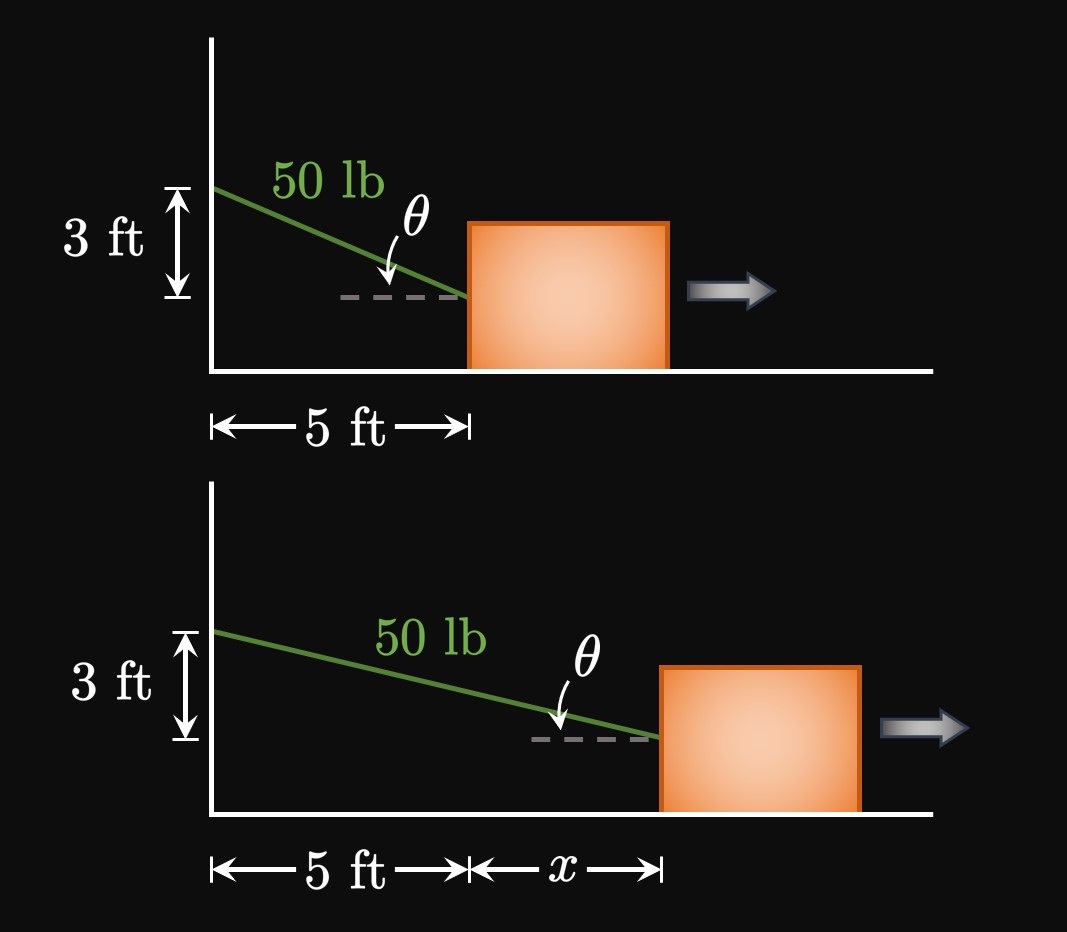
A box located \(5\) feet away from a wall is pinned at a spot \(3\) feet above.
The applied pull along the rope is maintained at \(T = 50\) pounds.
The box is then pushed away from the wall;
at any moment, the box has traveled \(x\) feet.
(See Figure 2.)
After sliding \(1\) foot, the box stops due to the opposing rope force.
By assuming that \(T\) is constant,
the work done by the rope on the box is
\[W = \int_0^1 -T \cos \theta \di x \cma\]
where \(\theta\) is the rope's variable angle of elevation.
Calculate \(W.\)
SOLUTION
Note that \(\theta\) is not constant, so we cannot take \(\cos \theta\) out of the integral.
Instead, \(\cos \theta\) represents a function of \(x \col\)
\[\cos \theta = \frac{x + 5}{\sqrt{(x + 5)^2 + 3^2}} = \frac{x + 5}{\sqrt{(x + 5)^2 + 9}} \pd\]
So the work is
\[
\ba
W &= \int_0^1 -T \par{\frac{x + 5}{\sqrt{(x + 5)^2 + 9}}} \di x \nl
&= -50 \int_0^1 \frac{x + 5}{\sqrt{(x + 5)^2 + 9}} \di x \pd
\ea
\]
Substituting \(x + 5 = 3 \tan \theta,\) we see \(x = 3 \tan \theta - 5\)
and so \(\dd x = 3 \sec^2 \theta \di \theta.\)
When \(x = 0,\) \(\theta = \atan(5/3);\) when \(x = 1,\) \(\theta = \atan 2.\)
For organization, let \(\alpha = \atan(5/3)\) and \(\beta = \atan 2.\)
Therefore, the work is
\[
\ba
W &= -50 \int_\alpha^\beta \frac{3 \tan \theta}{\sqrt{9 \tan^2 \theta + 9}} \, (3 \sec^2 \theta) \di \theta \nl
&= -50 \int_\alpha^\beta \frac{3 \tan \theta}{\abs{3 \sec \theta}} (3 \sec^2 \theta) \di \theta \nl
&= -150 \int_\alpha^\beta \sec \theta \tan \theta \di \theta \nl
&= -150 \sec \theta \intEval_\alpha^\beta \nl
&= 150 \sec \alpha - 150 \sec \beta \pd
\ea
\]
Since \(\alpha = \atan(5/3),\) we have \(\tan \alpha = 5/3\)
and so
\[
\ba
\sec^2 \alpha &= \tan^2 \alpha + 1 \nl
&= \par{\tfrac{5}{3}}^2 + 1 \nl
&= \tfrac{34}{9} \pd
\ea
\]
Thus, \(\sec \alpha\) \(= \sqrt{34}/3.\)
[We use the positive solution,
as \(-\pi/2 \lt \underbrace{\alpha}_{\atan \tfrac{5}{3}} \lt \pi/2\) and so \(\sec \alpha \gt 0.\)]
Likewise, because \(\beta = \atan 2,\)
we have \(\tan \beta = 2\) and thus
\[
\ba
\sec^2 \beta &= \tan^2 \beta + 1 \nl
&= (2)^2 + 1 \nl
&= 5 \pd
\ea
\]
Thus, \(\sec \beta\) \(= \sqrt 5.\)
[We use the positive solution,
as \(-\pi/2 \lt \underbrace{\beta}_{\atan 2} \lt \pi/2\) and so \(\sec \beta \gt 0.\)]
Accordingly, the work is
\[
\ba
W &= 150 \par{\frac{\sqrt{34}}{3}} - 150 \par{\sqrt 5} \nl
&= \boxed{50 \sqrt{34} - 150 \sqrt{5}} \nl
&\approx -43.863 \un{ft⋅lb}
\ea
\]
Because the work is negative,
the box has lost \(43.863 \un{ft⋅lb}\) of energy after sliding \(1 \un{ft}.\)